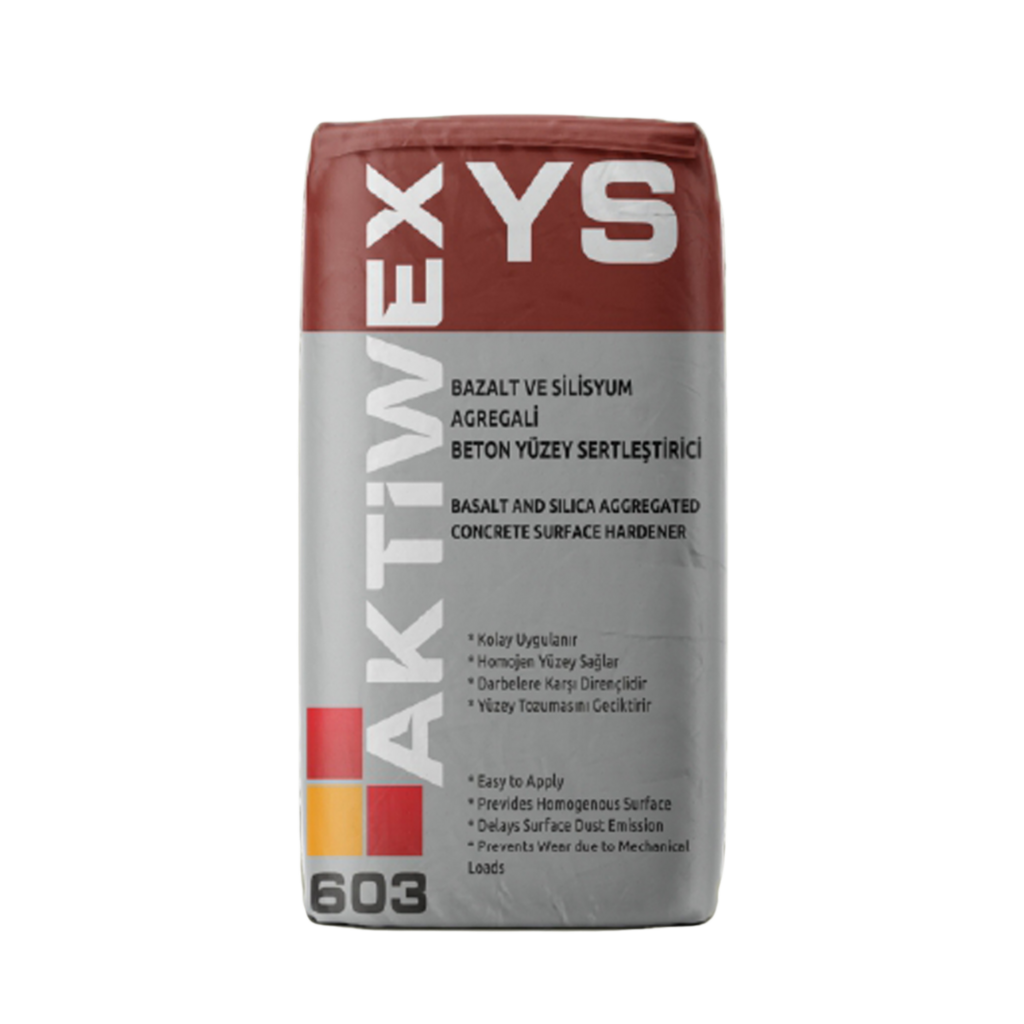
A cement-based, ready-to-use surface hardener material containing corundum and specially selected aggregates. It is applied in powder form by broadcasting onto fresh concrete surfaces that will be exposed to heavy loads.
Areas of Use
- In both indoor and outdoor areas,
- On industrial facility floors,
- In hangars and workshops,
- In garages and parking lots,
- In warehouses,
- In loading and unloading zones,
- On surfaces exposed to rubber-wheeled vehicle traffic,
- In aircraft hangars,
- On helicopter pads.
Features and Advantages
- Can be easily applied on freshly placed concrete flooring.
- Provides a smooth and homogeneous surface.
- Prevents wear caused by mechanical loads.
- Provides resistance against impact.
- Delays surface dusting.
Application
Surface Preparation: The quality of the supplied concrete must be consistent, and the entire surface should have uniform strength. The concrete slab must be fully compacted and prepared with a minimum water/cement ratio in class min.C225 (350 dosage, 25N/mm²). The thickness of the applied concrete must be at least 15 cm. Air-entrained concretes are not suitable for surface hardener applications. The surface of the fresh concrete to be treated must be leveled using a wooden float.
Application Instructions: Wait until the supporting concrete is firm enough to walk on. When walked on, the footprint depth should be between 0.5-1 cm. Depending on conditions, allow the bleed water to evaporate from the surface. In mechanical applications, 4–8 kg/m² of 603 should be spread at once using an automatic spreader and then evenly distributed. For manual applications, it is recommended to apply the material in two stages (first stage: 2/3 of the total amount; second stage: 1/3). A careful and homogeneous distribution must be achieved without creating waves on the surface. Do not throw the material from more than 2 meters away. Wait for the broadcasted material to absorb moisture from the concrete. A change in color indicates that sufficient moisture has been absorbed. Finishing must be done with a low-speed mechanical trowel (helicopter). Never add water to the surface treated with the surface hardener. Final smoothing can be done by hand or with a helicopter trowel. Any looseness or slurry on the surface indicates that the concrete is still fresh. As soon as the concrete reaches the appropriate hardening stage, preliminary finishing should be performed with a low-speed metal blade trowel at a minimum angle, and final finishing should be done at high speed.